
Why 2026 Could Be Nature's Breakthrough Year for Business
2025 saw a slowdown in public sustainability measures, with companies taking a more cautious approach amid regulatory uncertainty and waiting to see how new policies would unfold. For nature-related reporting, this slowdown was driven largely by the “Omnibus” proposal, which delayed adoption of the EU reporting standard on corporate impacts and dependencies on nature.
Despite that 2025 reality, we have hopeful predictions for 2026 based on some key nature risk developments from last year - actions that we believe will set the global community on a trajectory for widespread normalization of biodiversity assessment by 2030.
Four Key TNFD and Biodiversity Trends for 2026
In 2026, we will see:
More holistic TNFD-aligned reporting. In 2025, early adopters of the Taskforce on Nature-related Financial Disclosures (TNFD) published their first (and in some cases, second) round of TNFD-aligned reports. In 2026, we will see these reports mature and become more comprehensively aligned to the TNFD, a gap we identified in a recent report evaluating which datasets companies are using for TNFD assessments.
Many of these maturing reports will be showcased at COP17 in Armenia in late 2026, providing concrete evidence that nature risk assessment is both achievable and valuable – a powerful catalyst for broader adoption by additional companies.
Broader access to TNFD-aligned tools and platforms. The TNFD and Conservation X Labs finished out December 2025 with the Nature Intelligence for Business Grand Challenge, a global initiative that sought approaches to make nature risk assessment accessible for all SMEs. Solutions are being chosen and promoted in 2026, unlocking access for thousands of companies who may currently be too resource-constrained to conduct nature risk assessments. This will enable thousands of SMEs to assess their nature risks – and because these companies form the backbone of global supply chains, their assessments will cascade to the larger corporations they supply, creating comprehensive value chain transparency.
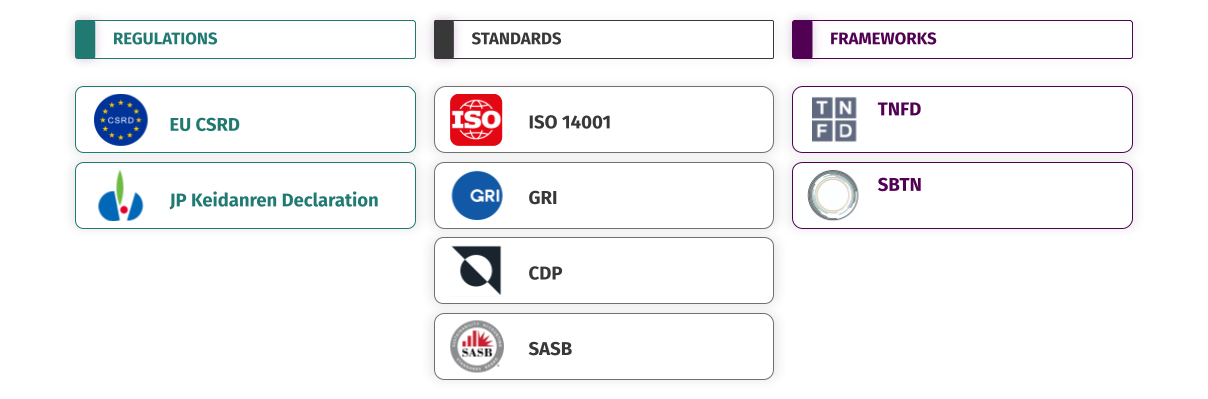
Wider use of the LEAP approach through framework alignment. Over 760 companies have voluntarily adopted the TNFD as of November 2025. But the potentially more powerful story is that thousands of companies already using existing sustainability frameworks will soon incorporate TNFD as these frameworks align. These represent substantial corporate reach, and in 2026, we expect to see the first wave of these aligned frameworks explicitly incorporating TNFD metrics:
4. Faster progress for companies just getting started. Companies that have not yet begun nature risk assessment will face a pivotal moment in 2026. While they may feel pressure as peers advance and stakeholders ask harder questions, they are actually entering at an advantageous time. The groundwork has been laid: proven methodologies, vetted datasets, real-world case studies, and purpose-built platforms, such as ours at Dunya Analytics, now exist to streamline what was once a resource-intensive process. What took early adopters months of trial and error can now be accomplished in hours or days with the right tools.
As corporate sustainability reporting standardizes nature and biodiversity risk assessment, companies will begin seamlessly integrating this information so that everyone is reporting on this information by 2030.
Ready to get started? Whether you are preparing for your first TNFD disclosure or need to manage risks across your operations, we are here to help you navigate this journey with confidence. We are excited about what 2026 will bring as corporate action on nature accelerates – and we are committed to working alongside you to turn nature commitments into measurable progress towards your company’s biodiversity goals.
