
How the new CMIP7 models reveal why nature conservation is a climate strategy
Nature conservation is not just a biodiversity goal. It is a bulwark against the uncertainties in how climate change will actually unfold. The Global Biodiversity Framework's 30x30 targets, which include protecting 30% of land and water and restoring 30% of degraded land by 2030, do more than safeguard ecosystems for biodiversity. They build the foundation of healthy, functioning natural systems that the world's climate models are increasingly counting on, and that the world will need regardless of how accurate those models turn out to be.
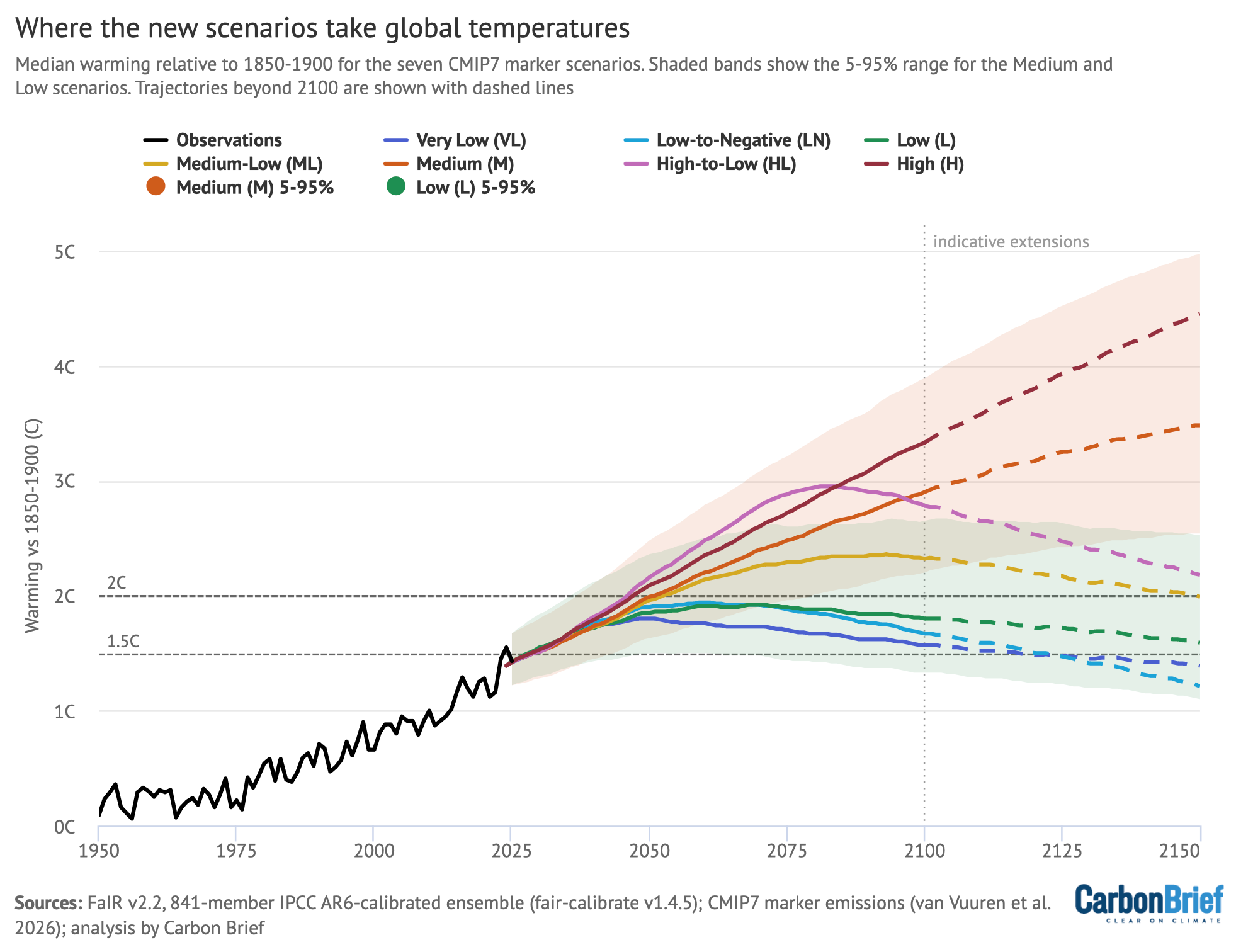
The new CMIP7 climate scenarios, released in 2026, illustrate why. Before, researchers told the models how much carbon dioxide (CO2) would be in the air at a given time. Now they feed the models actual emissions and let the models work out the CO2 levels, based on how carbon is absorbed by natural carbon sinks like forests, soils, and oceans. That shift puts natural carbon sinks at the center of how these models arrive at their warming projections. Every scenario that keeps warming within reach of the Paris Agreement targets relies on carbon dioxide removal (CDR) to get there, with natural carbon sinks in each of them.
What changed in CMIP7
Here are some other ways the scenarios have changed from the previous CMIP6 versions:
Rather than being named according to their “radiative forcing levels”, the new scenarios are more intuitively named by their emissions trajectories, ranging from “Low-to-Negative” to “High.”
They revise high-end future emissions downward, far below the highest scenarios in the past, since a 21st century dominated by coal use is no longer realistic.
The lowest emissions scenarios have shifted slightly upwards, since a future that avoids any overshoot of 1.5°C is also no longer considered plausible.
In the scenarios, CDR includes land-based removals, which involves both land-use sink and soil carbon management, as well as “engineered” and “novel” methods, such as direct air capture (DAC), bioenergy and carbon capture and storage (BECCS), enhanced weathering, and biochar.
However, even the scientists building these models cannot yet fully account for all of these engineered removal methods, since it is too early to establish a reliable way to track their actual climate effect.
Source: CarbonBrief
Where 30x30 fits in
The assumption that natural carbon sinks will continue to play a vital role in keeping our climate in balance only holds if ecosystems stay healthy and functioning.
The Global Biodiversity Framework’s 30x30 goals call on the global community to protect 30% of land and waters and restore 30% of degraded land by 2030. While the focus of this target is biodiversity, rather than carbon capture and sequestration, these goals could meaningfully contribute to carbon sequestration. In fact, one study found that restoring 30% of the planet could absorb half of all CO2 emissions.
Since some climate simulations include carbon absorption by natural systems, the models assume a certain level of healthy, functioning ecosystems. Furthermore, some of the CMIP7 scenarios show declining warming trends after 2050, which align with ecosystem recovery after the 30x30 protection targets are met in 2030. It takes anywhere from 10 to 100+ years for an ecosystem to fully recover and reach its full absorption capacity.
A bulwark for uncertainty
Though these climate scenarios are created by the best global, scientific teams, much uncertainty still exists in the models and reality could play out differently. Summer 2026 illustrated this: extreme heat trends are largely underestimated in climate model simulations. While CMIP7 will introduce major structural upgrades, extreme heat trends – especially regional, record-shattering heatwaves – may still be underestimated due to the complexity of creating global models.
The clearest defense against this uncertainty is nature conservation and restoration – not just about carbon capture, but for general resilience to climate change. Healthy natural ecosystems provide numerous benefits including:
Disaster protection: Wetlands, mangroves, and coral reefs absorb wave energy, reduce flood risks, and prevent coastal erosion.
Biodiversity buffers: Diverse ecosystems are inherently more stable. If one species struggles due to changing temperatures, another may be able to step in to keep the food web and ecosystem functions intact.
Local adaptation for humans: Ecosystems secure clean water, reduce local heat effects, and stabilize soil and agriculture for communities.
These benefits matter because nearly all of the scenarios show emissions and their subsequent warming continuing to climb before any of them start declining after 2050. That increased warming will likely intensify impacts on communities and infrastructure, which is exactly when nature’s resilience will be critical.
In this way, 30x30 is not just a biodiversity target. It is protecting the infrastructure that the climate models count on, and it's a bulwark against the models’ uncertainty.
What this means for companies
Companies have a direct stake in this, beyond biodiversity reporting or corporate responsibility goals. As companies work out their net-zero pathways, many are counting, implicitly or explicitly, on the same natural systems on which the climate models depend: stable forests, healthy soil, functioning carbon sinks. If those systems degrade, the math behind those pathways gets shakier.
That makes land and ocean protection and restoration less of a side commitment and more critical for risk management. A company that supports 30x30 initiatives, through supply chain choices, land use practices, or direct investment in conservation, is not just contributing to a biodiversity target. It is helping secure the infrastructure its own climate strategy is quietly assuming will still be there.
