
Transition Risk: What Your Biodiversity Data Reveals
This information is adapted from a webinar led by Dunya Analytics and IBAT. You can access the full webinar here.
If you are familiar with the Taskforce on Nature-related Financial Disclosures (TNFD), then you know that location-based assessment is a core starting point for understanding nature-related dependencies, impacts, risks, and opportunities across your operations. But how do the results from that assessment help identify transition risks? Operating near sensitive ecosystems creates financial exposure through multiple transition risk pathways. Here we describe these pathways and what types of datasets can help reveal transition risks.
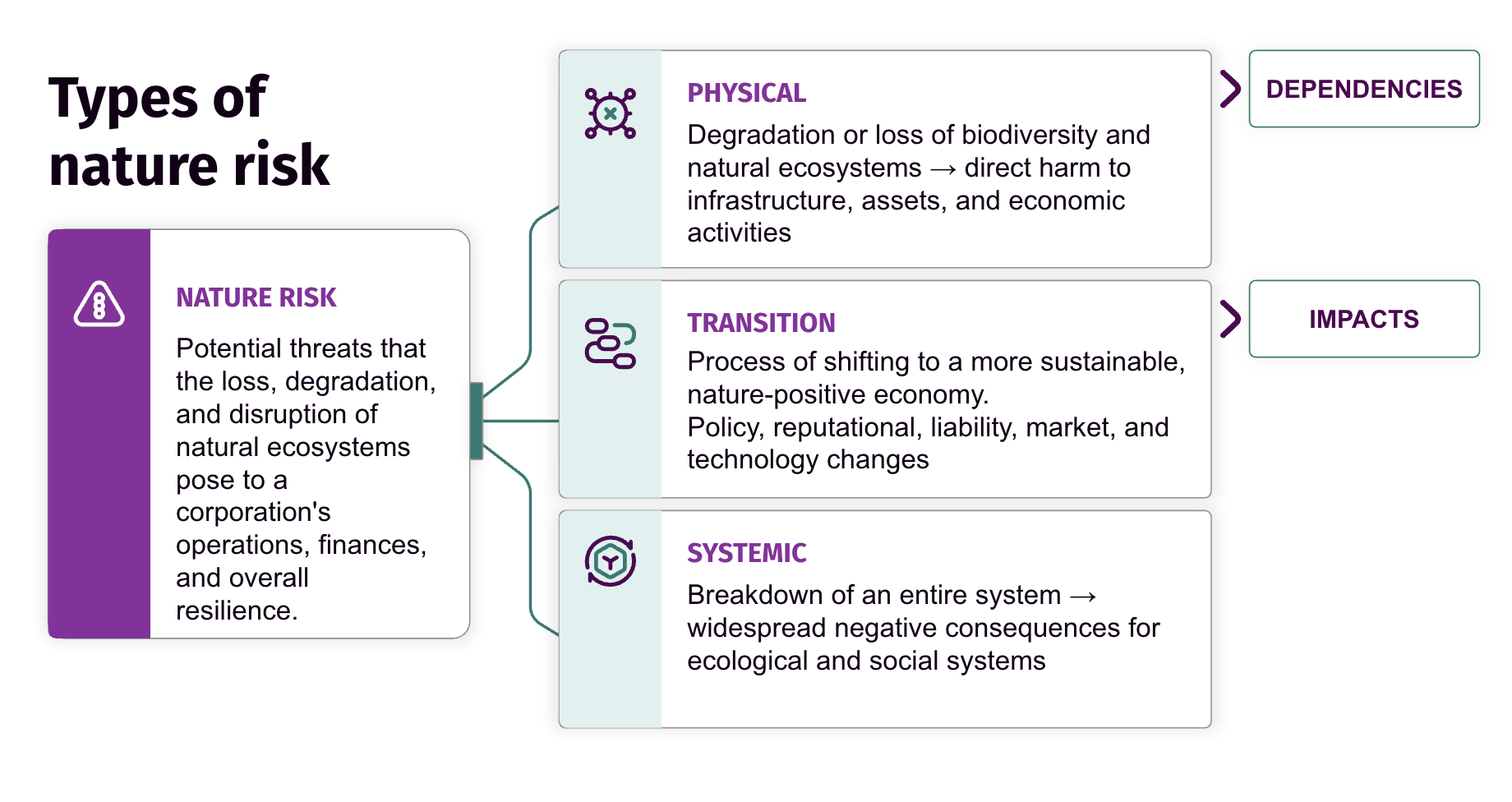
The TNFD defines three types of nature-related risk.
What are transition risks?
You can think about transition risks with this question: What could financially hurt my business because the world is changing to become more nature-positive? Those changes may come from governments, investors, consumers, competitors, technology, or public opinion.
The TNFD describes five types of transition risks, defined here with their core questions:
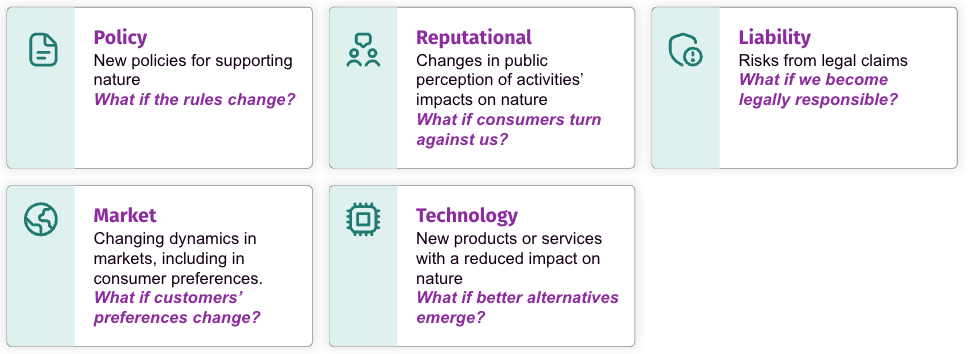
Not all of these transition risks are driven by where you operate. Market and technology risks are connected to other business decisions, such as product design.
Here we focus on policy, reputational, and liability risk since they are connected to the location of your operations and suppliers. These risks emerge when you have material negative impacts – such as pollution, intense water use, or transformation of land – in an area important for communities or biodiversity.
You assess these risks by asking if your operations or suppliers are operating near:
Indigenous or Community Lands. These lands overlap with some of the most biodiversity-rich, intact areas. If your company is negatively impacting the ecosystems on which these communities depend, you may be infringing on their health or livelihoods. That exposure carries both liability risk and reputational risk, as Indigenous land rights attract significant attention from investors, NGOs, and media.
Infringing on rights of Indigenous Peoples
Consider Vedanta Resources, a mining company that received government clearances to mine in the Niyamgiri Hills area of India – a biodiverse landscape and sacred homeland of Indigenous Peoples with no formal protected area status. India's Forest Rights Act required free, prior, and informed consent from Indigenous village councils before development could proceed.
Vedanta was found to have violated this and multiple environmental regulations, triggering the legal loss of its clearances and damage to investor relationships. The company lost access to a significant bauxite deposit it had already received permission to develop, and the case drew international attention and triggered divestment by major institutional investors.
At Dunya Analytics, we integrate available data on Indigenous and Community Lands in our platform so you can see where your business locations may be in proximity to these lands.
Existing protected or conserved areas. A protected area is a clearly defined geographical space, recognized, dedicated and managed, through legal or other effective means, to achieve the long-term conservation of nature with associated ecosystem services and cultural values. If you operate in proximity to one of these areas and have impacts such as pollution emissions, land transformation, or water use, those practices can degrade the ecosystem and undermine the functions and species that protected areas are designed to preserve.
Regulatory scrutiny is often highest in these areas, which could lead to policy risk, and perceived negative impacts carry significant reputational risk.
Clearing Land within Protected Areas
Investigative reporting uncovered that many of the sourcing mills for AAK AB, a Swedish oils and fats firm, extracted oil from illegally grown palm fruit in Indonesia, in which land clearance and deforestation are explicitly prohibited. After this news report was released in 2023, the company's share price dropped 5.5% within 24 hours.
Sourcing from suppliers operating within legally protected ecosystems compounds reputational risk, since violations of protected area boundaries carry both legal weight and heightened public visibility that accelerates investor response.
The World Database on Protected and Conserved Areas, hosted on IBAT, identifies areas that are already under legal or other types of protection.
Areas not currently under protection, but most likely to come under protection in the future. As countries seek to contribute to the 30x30 target, set under the Kunming-Montreal Global Biodiversity Framework (KM-GBF), areas identified as critical to biodiversity but not yet legally protected may become key candidates for designation as protected areas. This indicates an emerging policy risk if you operate near one of these important biodiversity areas. Even if they don’t come under protection, reputational risk can emerge if your company is perceived to have negative impacts on these critical locations.
The World Database on Key Biodiversity Areas, accessible through IBAT and available on the Dunya Analytics platform, describes sites critical for the preservation of life on Earth that contribute significantly to the global persistence of biodiversity. In fact, the coverage of Key Biodiversity Areas by protected areas and other effective area-based conservation measures (OECMs) is part of the KM-GBF monitoring framework. The same metric is also used in the Sustainable Development Goals (SDGs), where it underpins indicators measuring the coverage of important biodiversity sites by protected areas and other effective area-based conservation measures (OECMs).
Areas with threatened species. Threatened species are those at risk of extinction and may be protected by laws or regulations. Proximity to known habitats of threatened species can be a source of legal (including criminal) risk. Policy risk can also emerge as stricter rules related to protecting species are enforced.
Threatened Species Carry Protections
A land clearing company in Canada was subcontracted to work on a municipal road construction project. The project site contained specific plants on which the endangered Mottled Duskywing butterfly lays its eggs. Before any land clearing was allowed to begin, the plants were required to be dug up and moved to a nearby location to preserve the butterfly habitat. However, the company cleared the site before the required permit was issued, destroying habitat and resulting in criminal conviction in 2025.
The IUCN Red List of Threatened Species is the most comprehensive global information source on the extinction risk of species. It can be used to help identify threatened species that you should be aware of near your operations. The IUCN RHINO approach, which leverages the STAR metric, puts those species into a global context to help you understand which locations should be prioritized to reduce species extinction risk, and guides organizations on what to do, where to act, and how to measure progress towards Nature Positive outcomes.
Areas in rapid decline in integrity. Areas experiencing rapid deterioration in their ecological health and resilience warrant priority attention, both to prevent further deterioration and because conditions may still be reversible. Companies contributing to that decline face policy risk through regulatory penalties, and reputational risk through investor withdrawal and loss of customer relationships, both of which can restrict access to capital markets.
Deforestation in the Supply Chain
JBS, one of the world's largest meat processors, was linked to deforestation in its supply chain. In 2017, the company paid $8M in fines, lost investors and customers, and had its IPO delayed as capital markets priced in nature-related liability.
On the Dunya Analytics platform, we assess areas of rapid decline through analyzing both forest loss and land degradation.
These global datasets, curated by IBAT, make it possible to understand your emerging transition risks. Companies that map these exposures early can select development sites with lower risk, engage suppliers, or proactively work with communities and regulators.
Your locations may already be linked to transition risks. Book a demo with Dunya Analytics and learn how we’ve made it easy and accessible to identify and understand these risks.
